Flushing a Water Main: Velocity Scours, Not Flow
The Problem
“We flushed it” and “we scoured it” are not the same claim, and the difference is velocity. Opening a hydrant and moving a lot of water feels productive, but if the water is crawling through a big main it isn't lifting anything off the wall. What clears sediment, air, and biofilm is velocity — and reaching it on a large main is harder than it looks. I wanted a calculator that turns a target velocity into the flow it demands, and tells me whether that flow is even realistic from a hydrant.
The Approach
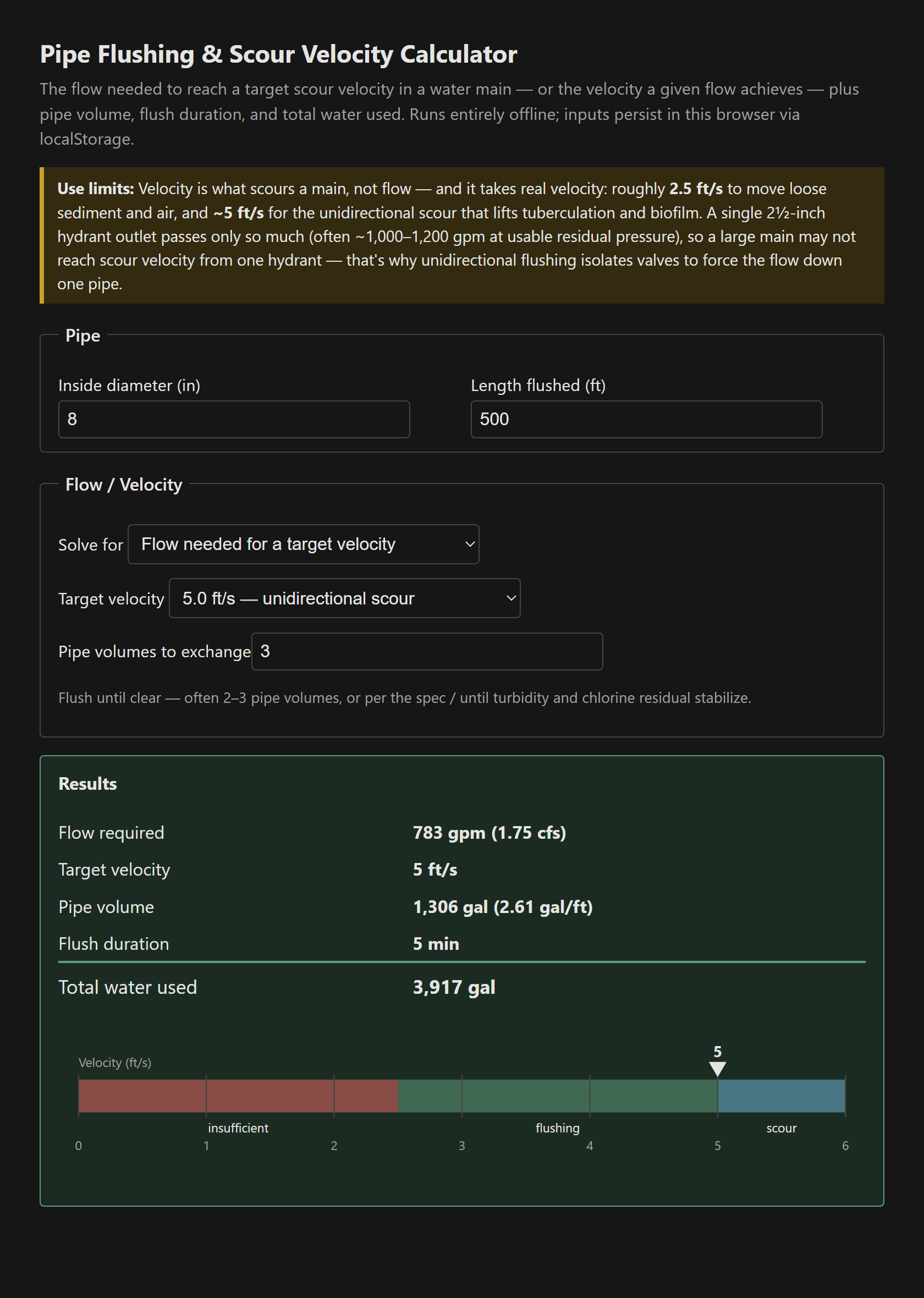
The full-pipe relationship is V (ft/s) = 0.4085 · Q (gpm) / D (in)², and inverted, Q = 2.448 · V · D². Give the tool a diameter and a target velocity and it returns the required flow; give it an available flow instead and it returns the velocity you'll actually get. It also works out the pipe volume (0.0408 · D² gallons per foot), the flush duration to exchange a chosen number of pipe volumes, and the total water used — the number you'll be dechlorinating and disposing of. A gauge places the velocity in one of three bands: below 2.5 ft/s is a rinse, 2.5–5 is conventional flushing, and 5+ is real scour.
Why big mains need unidirectional flushing
The D² in the denominator is the whole story. Velocity falls with the square of diameter, so doubling the pipe size quarters the velocity at the same flow. An 8-inch main hits scour velocity at a manageable ~780 gpm; a 16-inch main at the same flow is barely moving, and to scour it you'd need over 3,000 gpm — far more than any single 2½-inch hydrant outlet will pass at usable residual pressure. That's the entire reason unidirectional flushing exists: instead of opening one hydrant and hoping, you close valves to force the system's available flow down a single pipe, concentrating it until the velocity is actually there. The tool flags when the required flow outruns what a hydrant can give, which is the moment to stop wishing and start isolating.
Flushing field notes
- New-main disinfection (AWWA C651) flushes both before chlorination and to remove the heavily chlorinated water after — 2.5 ft/s is the usual floor. Pair this with the chlorine dosing calculator.
- Heavily chlorinated flush water must be dechlorinated before it hits a storm drain or stream; the total-water figure is what you're neutralizing.
- Open and close hydrants and valves slowly. A slammed hydrant spikes velocity, tears loose too much at once, and becomes discolored-water complaints across the neighborhood.
- Near the edge of what a hydrant can deliver? Confirm with a hydrant flow test, or isolate valves to concentrate the flow, before you commit to a velocity you can't actually reach.
Single static file, vanilla JS, everything persisted in localStorage and nothing leaving the browser.
The tool: Pipe Flushing & Scour Velocity Calculator.
References
- [1] AWWA C651 — Disinfecting Water Mains (flushing velocity and procedure).
- [2] AWWA M17 / unidirectional flushing program guidance. Companion tool: chlorine dosing & disinfection calculator.