Translating a Raw Ultrasonic Reading into Weir Flow
The Problem
An ultrasonic level element over a diversion weir reports a number in feet. The question on site is GPM. Between those two is a datum problem and a hydraulics problem: the instrument has no idea where the weir crest is, and the person reading it doesn't have Q = 2.5·H^2.5 memorized. The missing ingredient is one calibration fact — the true zero, the instrument's reading at the moment the water surface sits exactly at the crest. Capture that once and every future reading is a subtraction away from head, and head is a power law away from flow.
The Approach
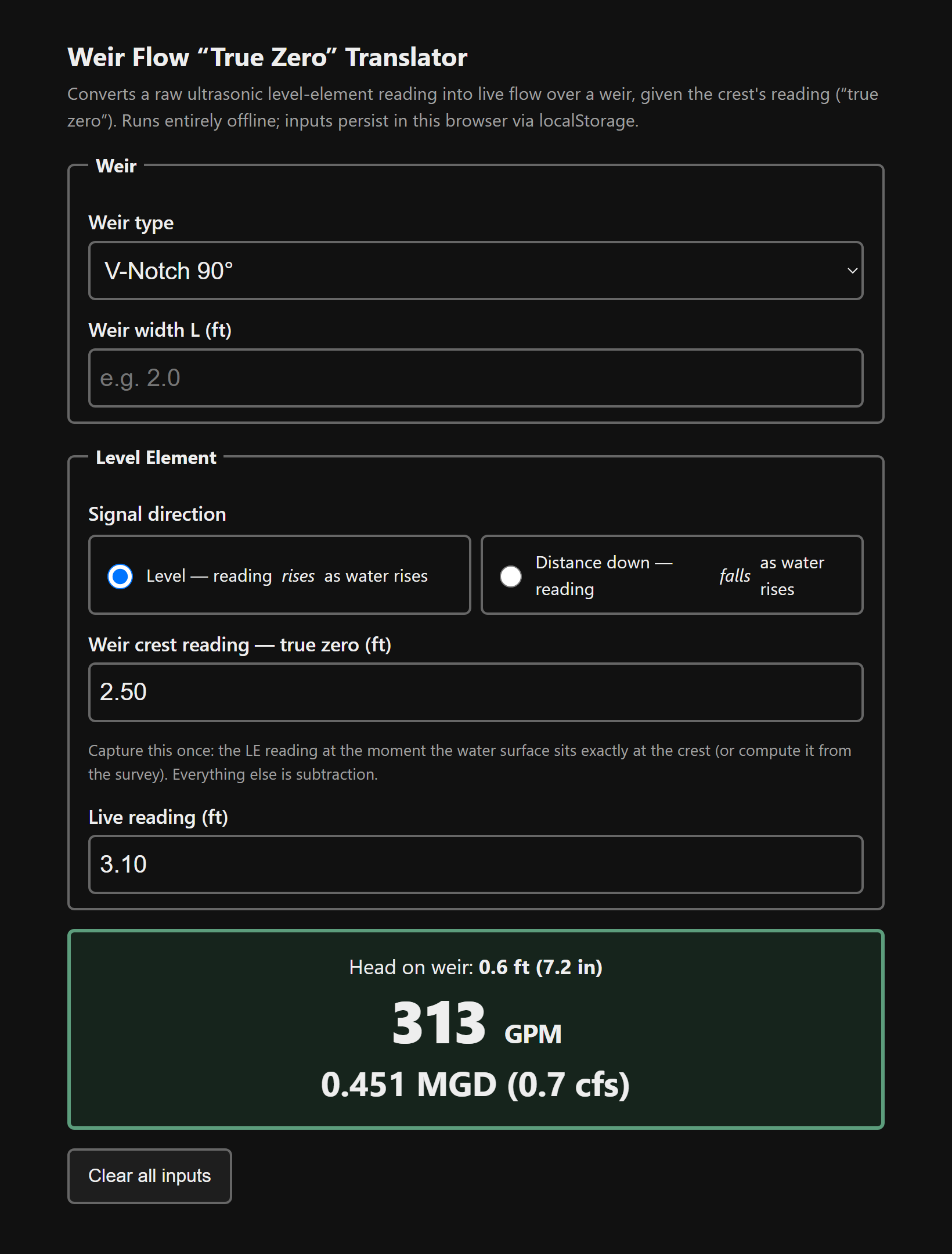
Enter the true zero, the weir type, and the live reading; the tool does the rest and prints GPM in numbers you can read from arm's length in sunlight:
H = live − true zero → Q = 2.5·H^2.5 (90° V-notch) or 1.443·H^2.5 (60°) or 3.33·L·H^1.5 (rectangular, suppressed)
with output in GPM, MGD, and cfs. If H comes out at or below zero, the tool says “water below crest — no flow” instead of printing a negative flow, and it warns outside the 0.2–2.0 ft band where sharp-crested formulas are actually rated [1].
The direction toggle
One wrinkle the simple subtraction misses: many ultrasonic LEs mounted above the channel report distance down to the water — the reading falls as the water rises. Subtract in the wrong direction and you get confidently wrong flow. The tool has a two-way toggle: level mode computes live − true zero, distance mode computes true zero − live. Either way, the true zero is captured the same way — note the reading when the water sits at the crest.
Accuracy fine print
- The weir must run free — air under the nappe, no submergence from downstream.
- Ultrasonics average over a footprint and dislike foam and standing waves; if the raw reading bounces, read the trend, not one sample.
- This is a startup verification device, not a billing meter. The fuller device set (Cipolletti, contracted rectangular, submerged orifice) lives in the Weir & Orifice Flow Calculator.
Single file, vanilla JS, inputs persisted in localStorage [2].
The tool: Weir Flow “True Zero” Translator.
References
- [1] USBR, Water Measurement Manual — weir formulas and installation conditions. https://www.usbr.gov/tsc/techreferences/mands/wmm/
- [2] ISO 1438 — Hydrometry: thin-plate weirs.