Checking Flotation Safety Before Draining a Structure
The Problem
A concrete basin full of water is heavy. A concrete basin full of air, sitting in saturated ground, is a boat — and structures have genuinely floated out of the ground: wet wells popping after backfill, basins lifting during a rehab because the plant next door kept the groundwater high. The dangerous moment is always a decision that feels routine: draining a tank for inspection, or turning off the well points over a weekend because the excavation looked dry.
The Approach
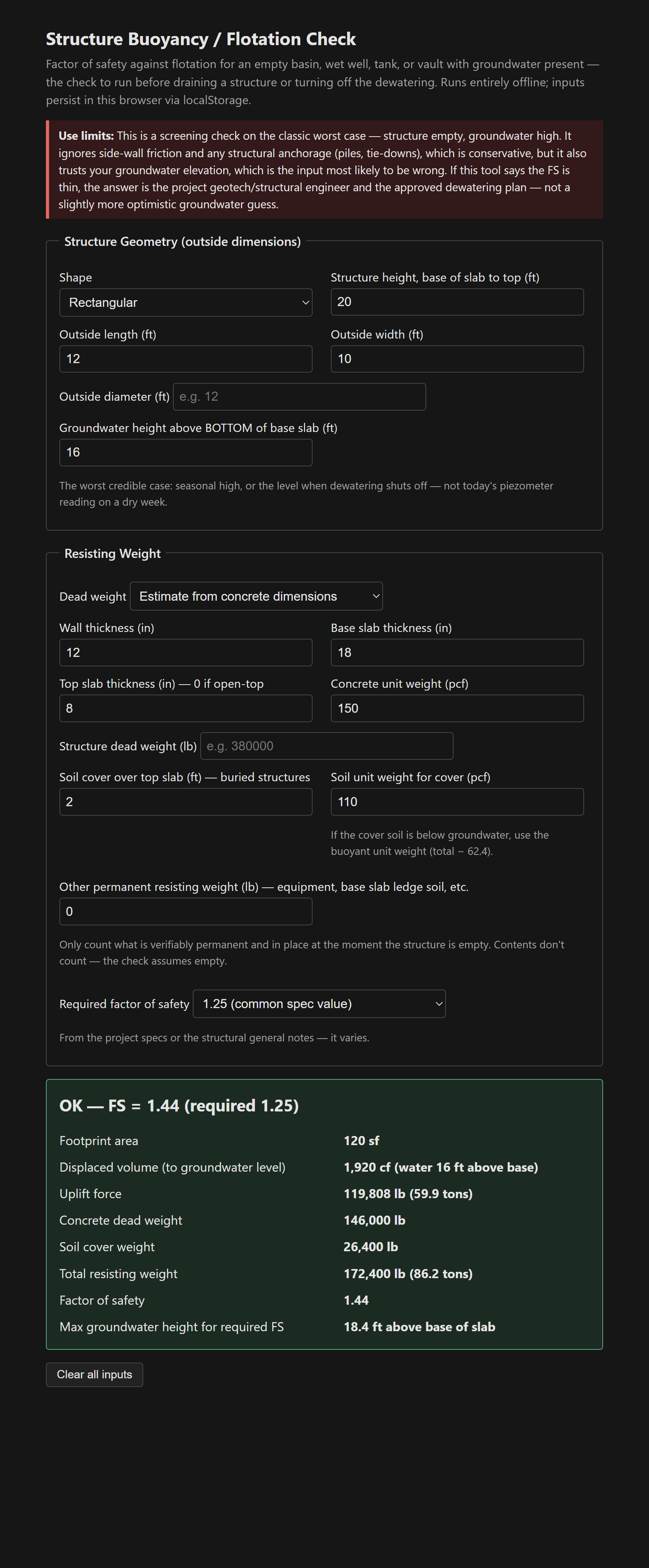
It's Archimedes, done honestly. Uplift is the footprint times the groundwater height above the base slab times 62.4 pcf; resistance is everything that actually pushes down:
U = A_footprint × h_gw × 62.4 FS = W_resist / U
where the resisting weight sums the concrete dead load (walls as the outside-minus-inside prism, plus base and top slabs), soil cover, and any entered permanent weight. The output I use most is the inversion: the maximum groundwater height at which FS drops to the required value. That number goes straight into the dewatering plan as a trigger — “keep the water below elevation X or the pumps stay on” [2][3].
What it deliberately leaves out
The tool's scope-limiting is a design feature, not laziness. Side friction and adhesion are real but unreliable — especially in soft or recently disturbed backfill — so like most flotation checks it neglects them, and anything they add is silent extra margin. Tension piles and rock anchors change the whole problem into a designed system, which a field check has no business approximating. And the check assumes the structure is empty, because empty is exactly the condition you're about to create the moment you drain it. A basin that's safe full and unsafe empty is the situation the tool exists to catch [1].
Field scenarios where this bites
- Draining an existing basin for rehab while the plant's other basins stay full — local groundwater at a working plant is often higher than the original borings suggest.
- New wet wells and vaults after backfill but before the equipment, top slab, or pavement the designer counted on — check the interim condition, not just the final one.
- Heavy rain filling a granular backfill zone faster than the native ground drains — a temporary perched water table right against your walls.
Single file, vanilla JS, localStorage persistence.
The tool: Structure Buoyancy / Flotation Check.
References
- [1] ACI 350 — Code Requirements for Environmental Engineering Concrete Structures (flotation provisions and load factors). https://www.concrete.org/
- [2] Project geotechnical report — design groundwater elevations (the governing input).
- [3] Approved dewatering plan — the document this check should send you back to when the FS is thin.