Circular-Mil Voltage Drop for Temporary Power Runs
The Problem
Temporary power on a job site means long runs: a generator a few hundred feet from a bypass pump, cord strung down the fence line to a trailer, a welder at the far end of the yard. Long runs mean voltage drop, and low voltage at a motor is sneaky — the motor draws more current to do the same work, which makes more heat, which is how a marginal temp feeder quietly cooks a rental pump motor over a week without ever tripping a breaker.
The Approach
The standard estimating method is the circular-mil formula:
Three-phase: V_d = √3 × K × I × L / CM Single-phase: V_d = 2 × K × I × L / CM
K is conductor resistivity in Ω·cmil/ft (12.9 for copper, 21.2 for aluminum at operating temperature), L is one-way length, and CM is the conductor's circular-mil area. Parallel sets split the current, which is arithmetically the same as multiplying CM. The method neglects reactance, which is fine at high power factor and modest conductor sizes — exactly the temp-power regime [1].
The result gets checked against the NEC's familiar 3%/5% guideline. Worth knowing: that's an informational note, not a code mandate — a recommendation for “reasonable efficiency of operation.” But motors, VFDs, and contactor coils all get grumpy well before the lights dim, so the guideline is a sensible field line to hold.
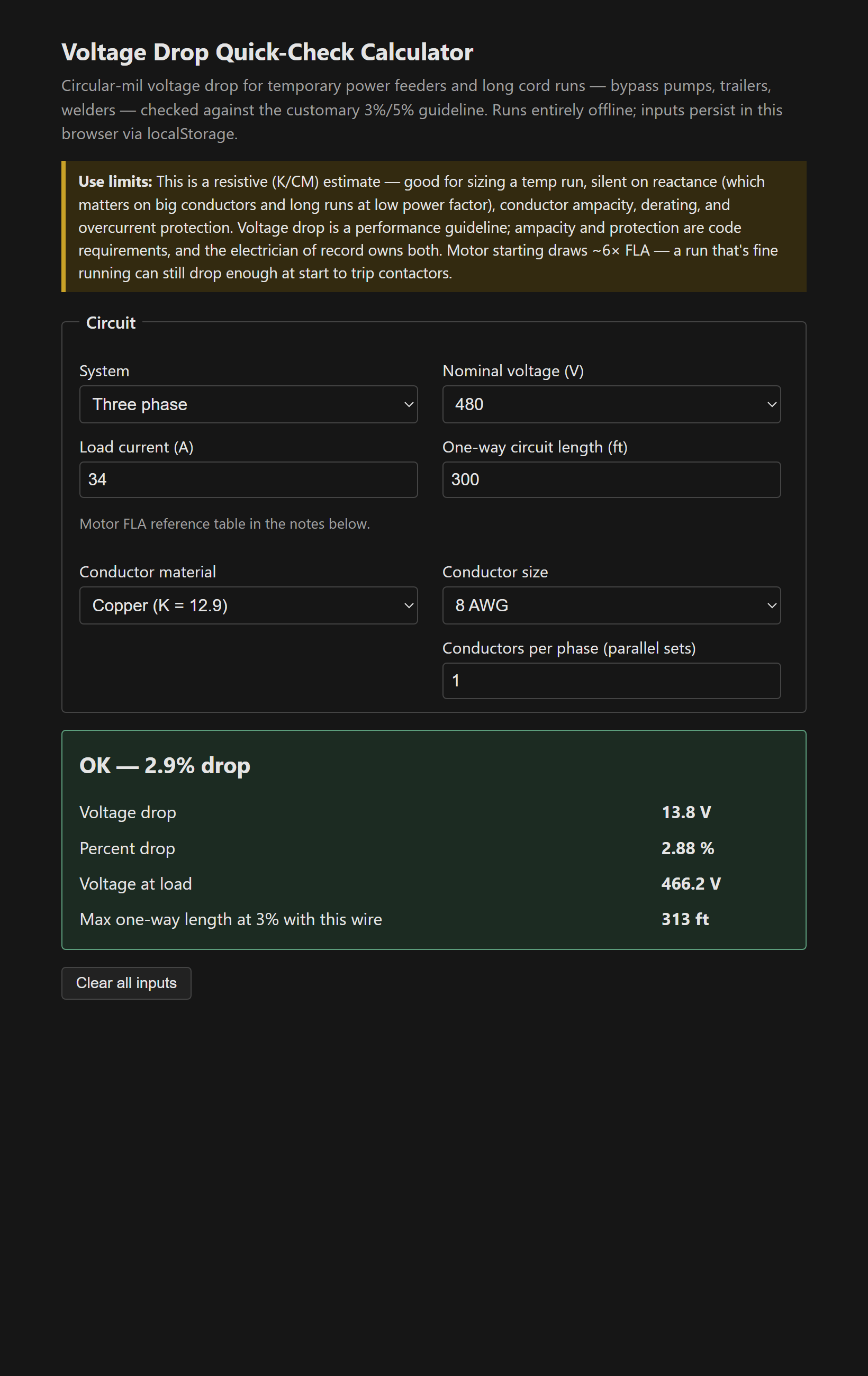
Since the current draw is the input you rarely have memorized, the tool carries the NEC Table 430.250 motor FLA values for 460 V three-phase motors (a 25 HP pump pulls 34 A, a 100 HP pulls 124 A) — table values, which are what sizing uses, not nameplate [1].
Scope note
This is a voltage-drop estimator, deliberately. Ampacity, overcurrent protection, grounding, and anything that becomes permanent belong to the electrician and the electrical engineer of record — the tool says so on its face rather than pretending a drop calc is a circuit design [2].
Single file, vanilla JS, localStorage persistence.
The tool: Voltage Drop Quick-Check Calculator.
References
- [1] NFPA 70 (NEC) — Art. 210/215 informational notes on voltage drop; Table 430.250 motor FLA; Chapter 9 Table 8 conductor properties. https://www.nfpa.org/
- [2] The electrician / electrical engineer of record — ampacity, protection, and anything permanent.