Trench Quantities in Bank, Loose, and Compacted Yards
The Problem
Trench quantities are prism arithmetic — width times depth times length, minus the pipe. Nobody gets the prisms wrong. What goes wrong is that the same dirt is three different volumes depending on where it's sitting: in the ground, in the truck, or compacted back in the trench. Order bedding rock off the neat-line number and you run short; schedule haul-off trucks off the bank volume and you're a truck or two light every day; and the supplier's tickets are in tons while the inspector thinks in cubic yards.
The Approach
The neat-line volumes are the easy part, all in bank measure:
Excavation = W × D × L Pipe zone = W × (OD + h_zone) × L − V_pipe
where the pipe displaces π/4 × (OD/12)² × L. The tool then converts each stream to the measure that matters for it [2]:
- Bank CY — in the ground, undisturbed. The neat-line numbers.
- Loose CY — bank × (1 + swell). What the trucks haul, so what hauling gets priced and scheduled on.
- Compacted CY — what the delivered loose yard shrinks to at spec density, which is why import gets a compaction/waste allowance on top of neat-line.
It finishes the chain with import tonnage at the material's density and a truckload count, because that's the number the phone call to the yard actually needs.
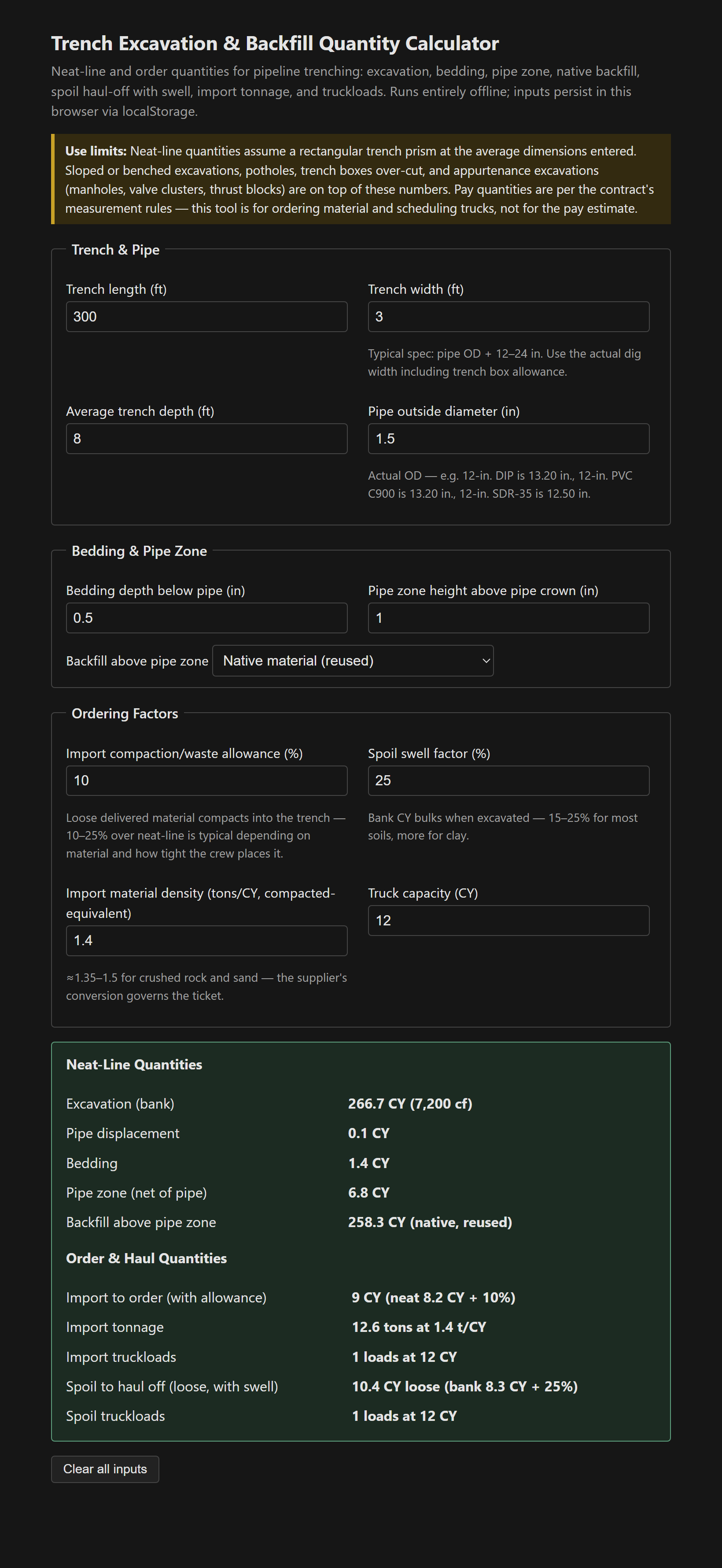
Field notes that ride along
- Depth varies along a run on grade — use the average of station depths, or split into reaches and run the tool per reach.
- If a trench box sets the dig width, use the box width plus 6–12 in. of over-cut, not the spec minimum trench width.
- Unsuitable subgrade means over-excavation and extra bedding — a re-run with the deeper numbers is the change-order quantity backup, dated the day it happened.
- Keeping bank/loose/compacted straight on the daily report saves the argument at the pay application.
Single file, vanilla JS, inputs persisted in localStorage. Measurement-and-payment rules in the contract spec govern what's actually payable — this computes what's actually in the ground [1].
The tool: Trench Excavation & Backfill Quantity Calculator.
References
- [1] Contract specifications — trench detail, bedding/zone materials, and measurement/payment rules (governing).
- [2] Caterpillar Performance Handbook — swell/shrink factors by material type.
- [3] Pipe manufacturer dimension tables — actual ODs by material and pressure class.