Hydrotest Makeup Water and the 148,000 vs 133,200 Divisor
The Problem
Pressure-testing a gasketed-joint water main, you fill it, pump it up to the test pressure, and hold. A little water always goes in over the hold — trapped air dissolving, gaskets seating — and the spec gives you an allowance for it. The formula is short: Q = S · D · √P / 148,000 gallons per hour, length times diameter times the square root of pressure over a constant. What sent me down a small rabbit hole was that constant, because I kept seeing 133,200 in older specs and I wanted to know whether someone was wrong.
The Approach
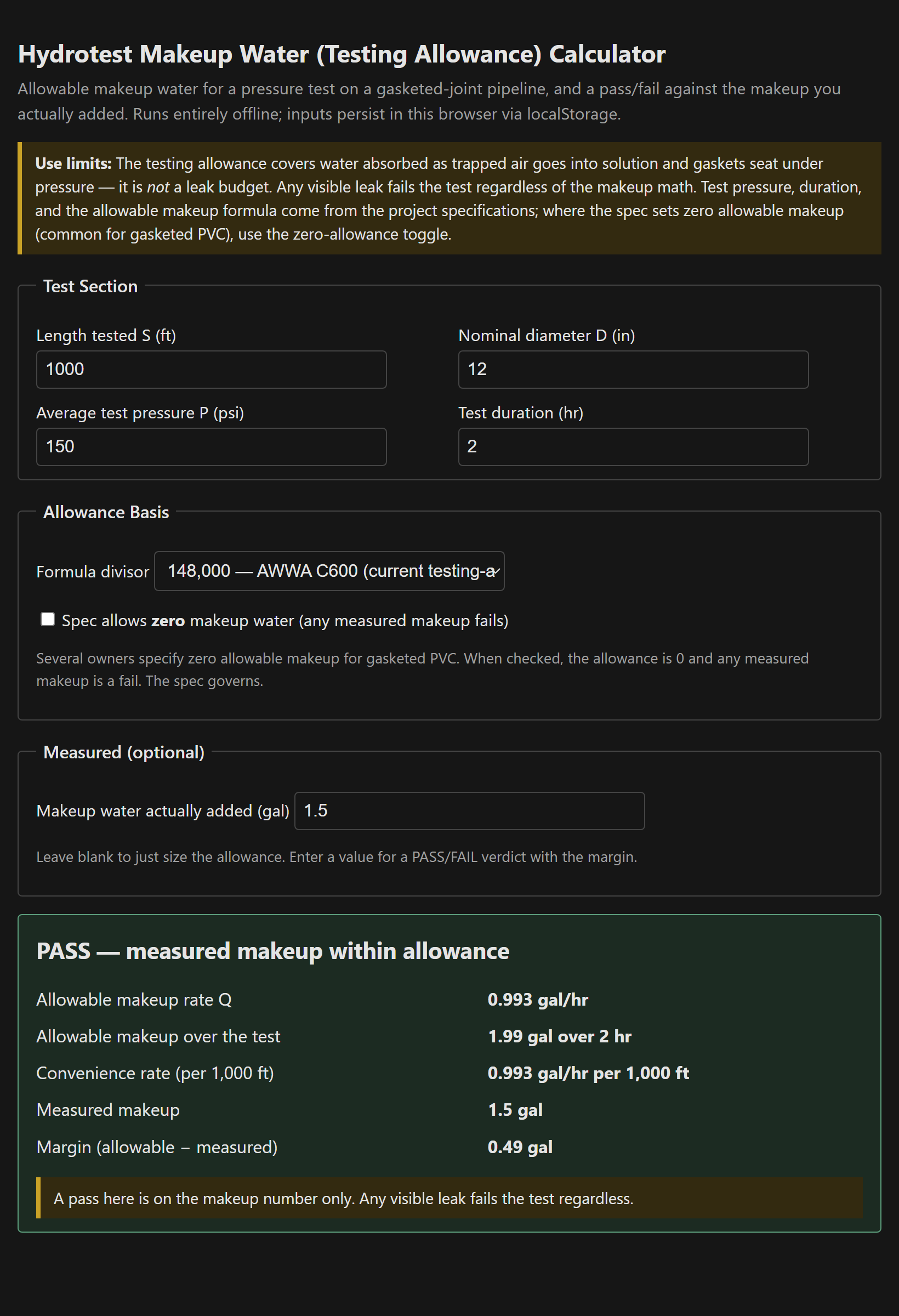
The tool takes the length tested, the nominal diameter, the average test pressure, and the duration, and returns the allowable makeup rate and the total over the test, plus a convenience per-1,000-foot number. Enter the makeup you actually measured and it renders a pass/fail with the margin. As a sanity check on the arithmetic: 1,000 feet of 12-inch at 150 psi average is 1000 · 12 · √150 / 148,000 ≈ 0.993 gal/hr, about 1.99 gallons over a two-hour test — a genuinely small number, which is the whole point.
Where 133,200 comes from
Neither divisor is wrong — they're the same formula written two ways. The current AWWA C600 testing allowance is expressed per foot of pipe, straight to S · D · √P / 148,000 [1]. Older editions and some specifications use the per-joint form, N · D · √P / 7,400, where N is the number of joints. With standard 18-foot laying lengths, N = S / 18, so the per-joint form becomes S · D · √P / (18 × 7,400) = S · D · √P / 133,200. The 133,200 divisor is simply the older joint-count allowance re-expressed per foot, and it yields a slightly larger allowance. The tool lets you pick whichever the spec cites — and, because several owners set zero allowable makeup for gasketed PVC, it has a zero-allowance toggle that turns any measured makeup into a fail [2][3].
Field notes on the hold
- The allowance covers absorbed air and gasket seating, not leaks. A joint weeping visibly fails even if the makeup is under the number — write it up and fix it.
- Temperature moves pressure. In a rigid, full line, roughly 1 psi per °F is a workable rule of thumb; a test that quietly bleeds pressure over a hot afternoon may be losing temperature, not water. Log air and water temperature at start and end.
- Measure makeup with a calibrated container or a meter on the pump, not a guess off the tank stick. The numbers are small, so the measurement has to be at least as precise.
- Fill and stabilize before the clock starts, so trapped air has worked out before you're on the record.
Test pressure, duration, and the allowable makeup all come from the project specifications [3] — this just does the archaeology and the arithmetic so the number on the test report matches the standard the spec actually cites. Single file, vanilla JS, everything persisted in localStorage and nothing leaving the browser.
The tool: Hydrotest Makeup Water (Testing Allowance) Calculator.
References
- [1] AWWA C600 — Installation of Ductile-Iron Mains and Their Appurtenances (hydrostatic testing and allowable leakage/makeup).
- [2] AWWA C605 — Underground Installation of PVC and Molecularly Oriented PVC Pressure Pipe (testing provisions).
- [3] Contract specifications — governing test pressure, duration, and allowable makeup, including any zero-allowance provision.