Rendering SVGs Locally
Translating arbitrary Extensible Markup Language (XML) vector strings into rasterized static image formats historically required dependencies like ImageMagick or Inkscape. However, the HTML5 Canvas API natively supports painting serialized SVG blobs onto a local rendering context, negating the requirement for server-side processing architectures entirely.
This localized implementation utilizes a DOMParser to extract coordinate parameters directly from the viewBox vector constraint. The underlying XML is subsequently converted into a transient Blob and allocated an Object URL. This URL is assigned to a virtual Image object, which is directly painted onto an offscreen canvas utilizing the drawImage() subroutine [1].
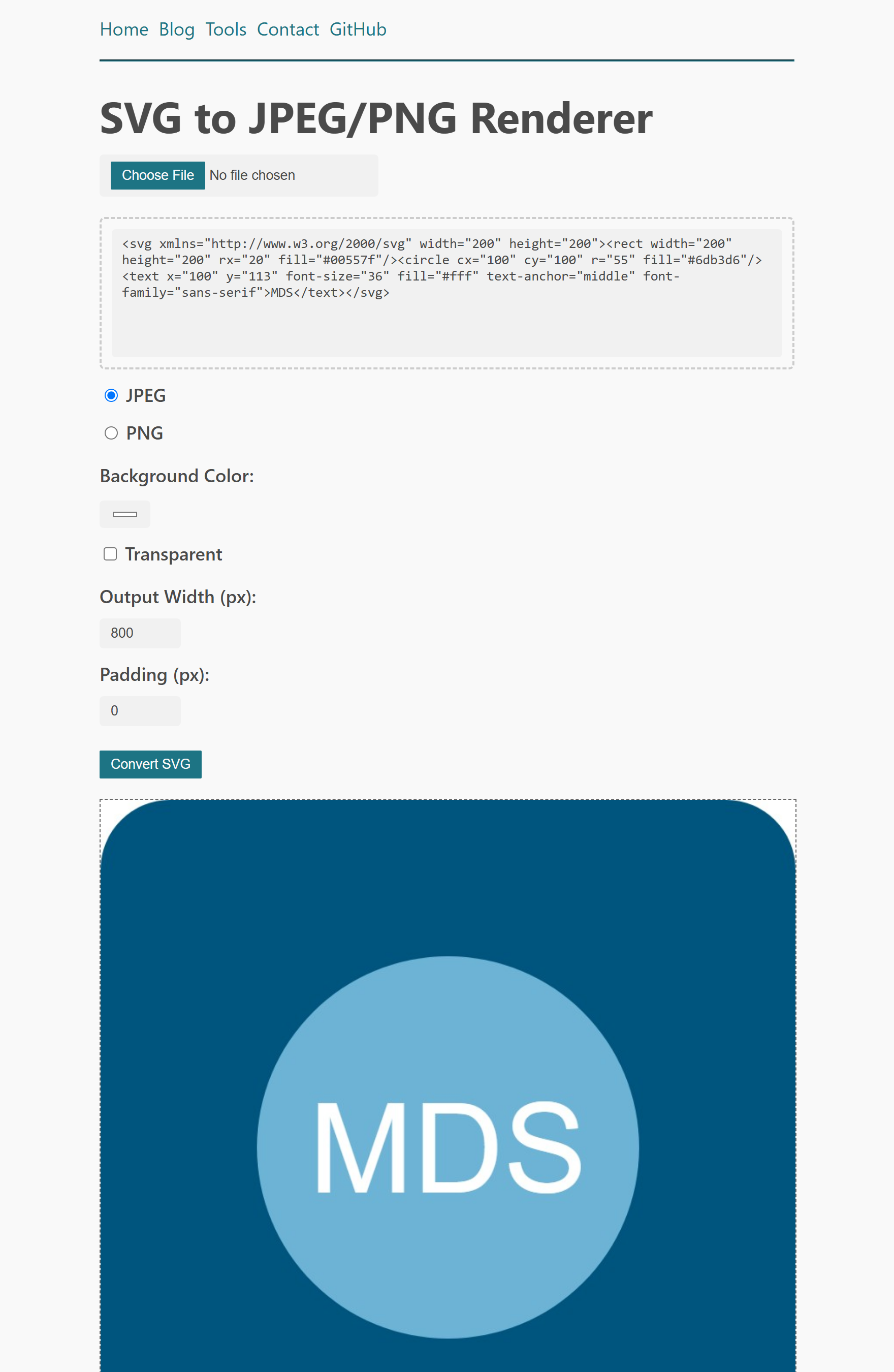
Once written to the canvas buffer, the resulting image is securely exported back to the user environment via the toDataURL() method, enforcing localized processing requirements. State synchronization between the textarea inputs and the rendering loop is constrained using standard debouncing algorithms to prevent pipeline blockages during active input [2].
Parsing SVG Dimensions
$ echo '<svg viewBox="0 0 400 300"></svg>' | grep -o 'viewBox="[^"]*"'
viewBox="0 0 400 300"
References
- Willison, S. "SVG to JPEG/PNG". Available: https://tools.simonwillison.net/svg-render.
- Willison, S. "svg-render.html Source Code". Available: https://github.com/simonw/tools/blob/main/svg-render.html.