Generating JavaScript Bookmarklets
Executing transient utility scripts against active browser Document Object Models (DOM) often necessitates the utilization of external browser extensions. This practice introduces pervasive security risks, as extensions generally request extensive cross-origin read/write permissions. Deploying vanilla JavaScript sequences as browser bookmarklets securely restricts arbitrary execution exclusively to the bounds of the active tab.
This toolkit aggregates highly specific, minified DOM manipulation subroutines wrapped within Immediately Invoked Function Expressions (IIFE). By prefixing these expressions with the javascript: protocol, the resulting Uniform Resource Identifiers (URIs) can be bound directly to a user's local bookmarks toolbar, completely eliminating dependency vectors [1].
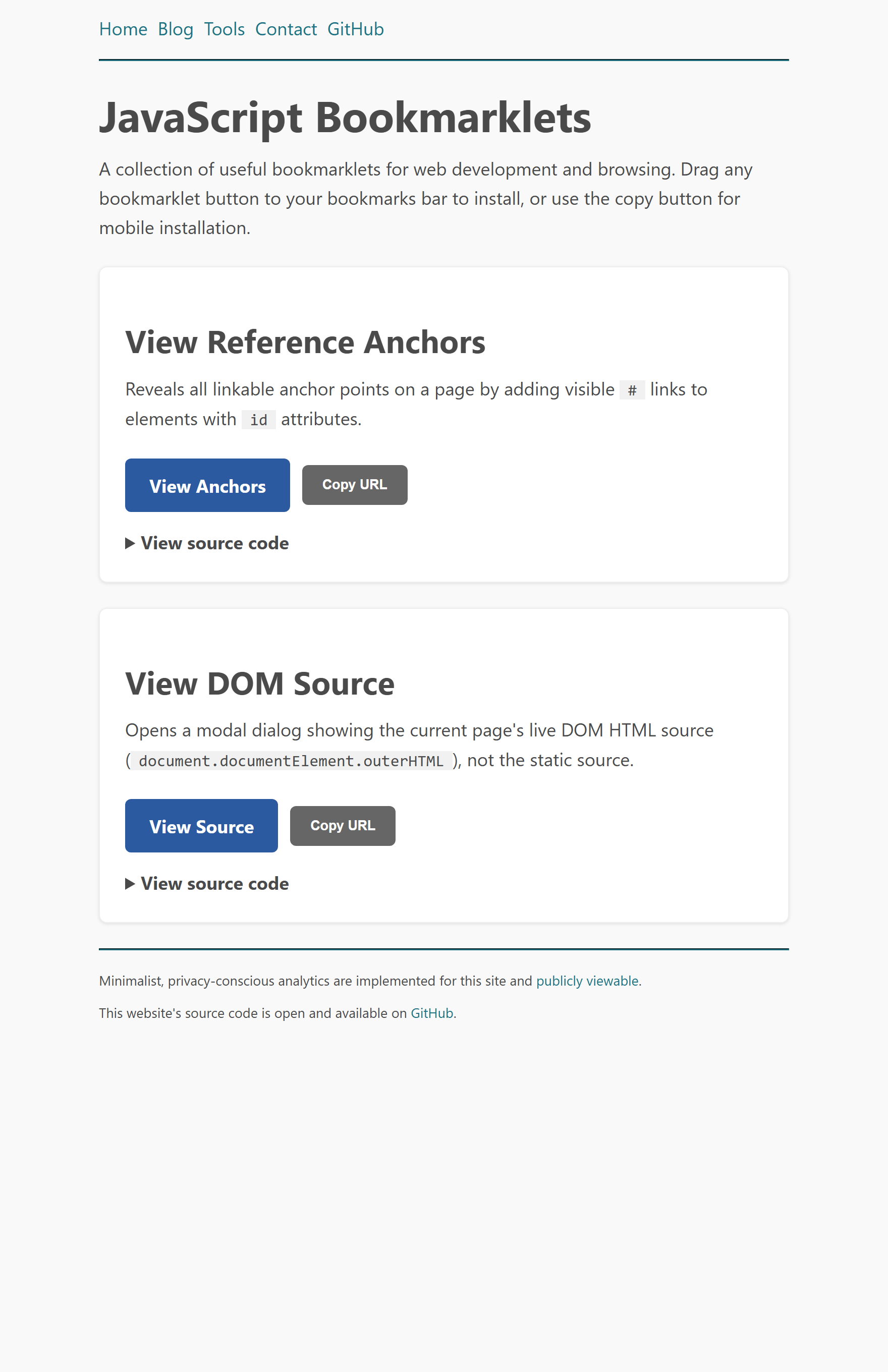
Notable included modules encompass an anchor extraction protocol, which queries all id nodes for deep-linking visibility, and an isolated source-code visualization matrix mapping the document.documentElement.outerHTML attribute into a stylized floating modal [2].
Standard IIFE bookmarklet syntax
$ echo 'javascript:(function(){alert("Executed");})();'References
- Willison, S. "Bookmarklets Collection". Available: https://tools.simonwillison.net/bookmarklets.
- Willison, S. "bookmarklets.html Source Code". Available: https://github.com/simonw/tools/blob/main/bookmarklets.html.