Rebar Weight Takeoff and ACI 318 Lap Splice Lengths
The Problem
Two rebar questions come up constantly and neither is hard, but both are easy to fumble in a hurry. One: how much does this mat weigh, for the order and the crane pick? Two: how long is the lap? The lap question in particular gets answered from a dog-eared table that may or may not match the bar grade, the concrete strength, or the cover condition on this drawing — and a lap that's too short is a rejection, while a lap that's too long is steel you bought and bent for nothing.
The Approach
The takeoff side is a multi-line table of bar size, length, and count, using the ASTM A615 nominal weights (#4 at 0.668 lb/ft, #5 at 1.043, and so on) to total the tonnage. The splice side runs the ACI 318 simplified tension development equations. For deformed bars in tension with favorable spacing and cover (Case 1):
#6 and smaller: ℓd = (fy·ψt·ψe / (25·λ·√f′c))·db
#7 and larger: ℓd = (fy·ψt·ψe / (20·λ·√f′c))·db
Case 2 (tighter spacing/cover) multiplies both by 1.5. The code limits are built in: the product ψt·ψe is capped at 1.7, √f′c is capped at 100 psi, and ℓd never goes below 12 in. A Class B tension lap is 1.3·ℓd; Class A is 1.0·ℓd [1].
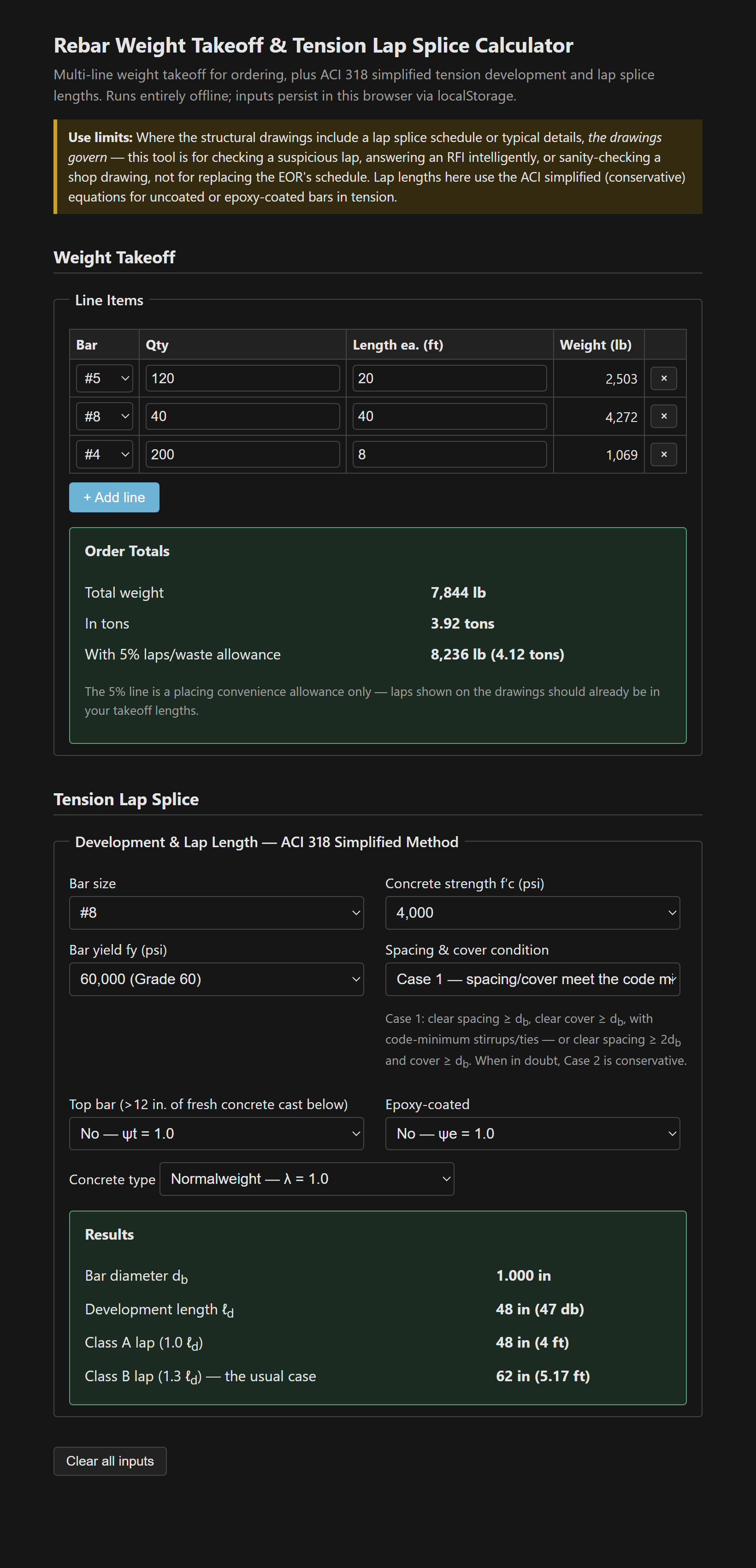
The tool defaults laps to Class B, which is what most drawings do unless noted — Class A needs at least twice the steel provided over the splice and no more than half the bars spliced in one place, conditions the field can rarely verify. It also flags the traps: #14 and #18 bars can't be lap spliced at all (mechanical or welded only), and Grade 80 laps run about a third longer than Grade 60, so the bar tags matter before you assume.
Why laps quietly blow the order quantity
Each splice adds one lap length of bar per splice. On a long wall built from 60-ft stock, that's a splice every stick, and the lap allowance adds up fast enough to matter at the order — which is exactly why the takeoff and the lap calc live in the same tool. Stagger and splice location are design decisions from the drawings; this only computes the length.
Single file, vanilla JS, the takeoff table and inputs persisted in localStorage.
The tool: Rebar Weight Takeoff & Tension Lap Splice Calculator.
References
- [1] ACI 318 — Building Code Requirements for Structural Concrete, development and splice provisions (Ch. 25 in current editions). https://www.concrete.org/
- [2] CRSI, Manual of Standard Practice — bar data and placing conventions. https://www.crsi.org/
- [3] ASTM A615 — deformed bar dimensions and weights.