The Water Units That Cause Real Errors, in One Converter
The Problem
Water and wastewater work runs on a fistful of units that don't play nicely together: flow in cfs, GPM, and MGD; volume in gallons, cubic feet, and acre-feet; rainfall as a depth that has to become a volume over an area. A generic unit converter doesn't know that a gallon of water weighs 8.34 pounds, and the mistakes here aren't rounding errors — they're factor-of-694 pump-sizing catastrophes.
The Approach
A domain converter across flow, volume, intensity, area, and rainfall-over-area, with live equivalents tables, plus a dedicated loading calculator built around the one equation plant operators use more than any other [2]:
lb/day = mg/L × MGD × 8.34
— because a gallon of water weighs 8.34 lb and mg/L is parts per million by mass. The rainfall category extends a depth to a volume over an acreage, closing the loop with the drainage tools.
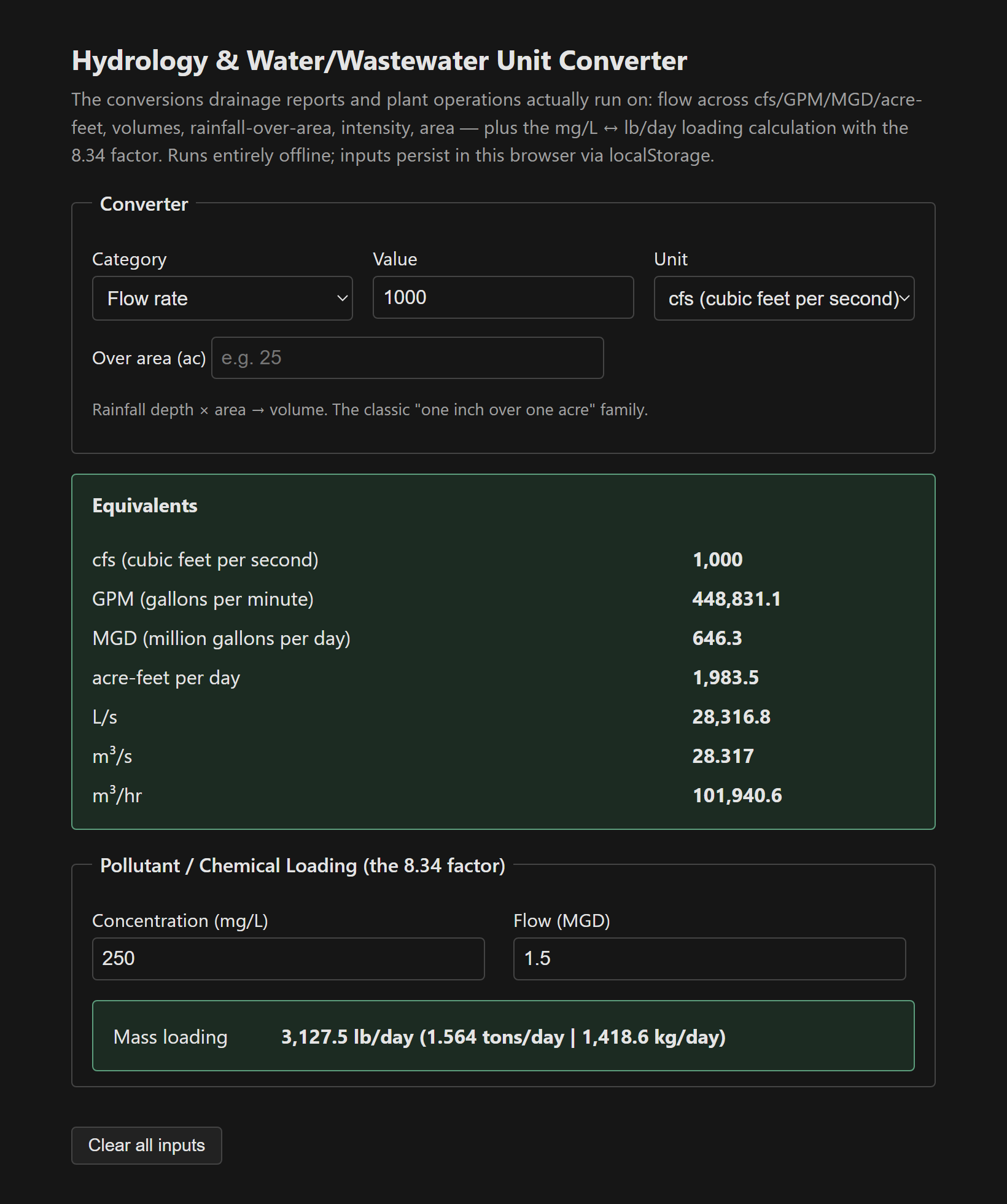
The factors worth memorizing anyway
1 cfs = 448.83 GPM = 0.6463 MGD ≈ 1.983 ac-ft/day— “a cfs is about two acre-feet a day.”1 MGD = 694.4 GPM = 1.547 cfs1 ac-ft = 43,560 cf = 325,851 gal;1 inch over 1 acre = 3,630 cf ≈ 27,154 gal1 cf = 7.4805 gal;1 m³ = 264.17 gal
The gotchas that cause the real errors
- MGD vs. GPM is the classic pump-sizing catastrophe — a factor of 694. If a station “needs 2” of something, make everyone say the unit out loud.
- Acre-feet vs. acre-inches: detention volumes get quoted in both, and a factor of 12 hides in the paperwork.
- cfs is instantaneous; MGD usually means daily average. Converting between them is arithmetic; equating a peak to an average is a design error.
Single file, vanilla JS, localStorage persistence. All gallons are US gallons; feet here are the ordinary international foot, which is fine for volumes — the survey-foot distinction matters for coordinates, not tanks (see the Coordinate Converter for where it does) [1].
The tool: Hydrology & Water/Wastewater Unit Converter.
References
- [1] NIST Handbook 44, Appendix C — general tables of units of measurement.
- [2] Any water/wastewater operator certification manual — the 8.34 formula and its uses.