Sizing Deflection Test Mandrels from the Base Inside Diameter
The Problem
Flexible sewer pipe — PVC, HDPE — deflects to whatever shape its bedding allows, which is why the mandrel pull exists: it's really a test of the embedment, not the pipe. The math is one line. The trap is in which diameter you multiply. An “8-inch” SDR 35 pipe doesn't have an 8-inch bore, and it doesn't have the nominal ID from the catalog either — the standard's base ID accounts for average walls and tolerances, and getting this wrong fails good pipe.
The Approach
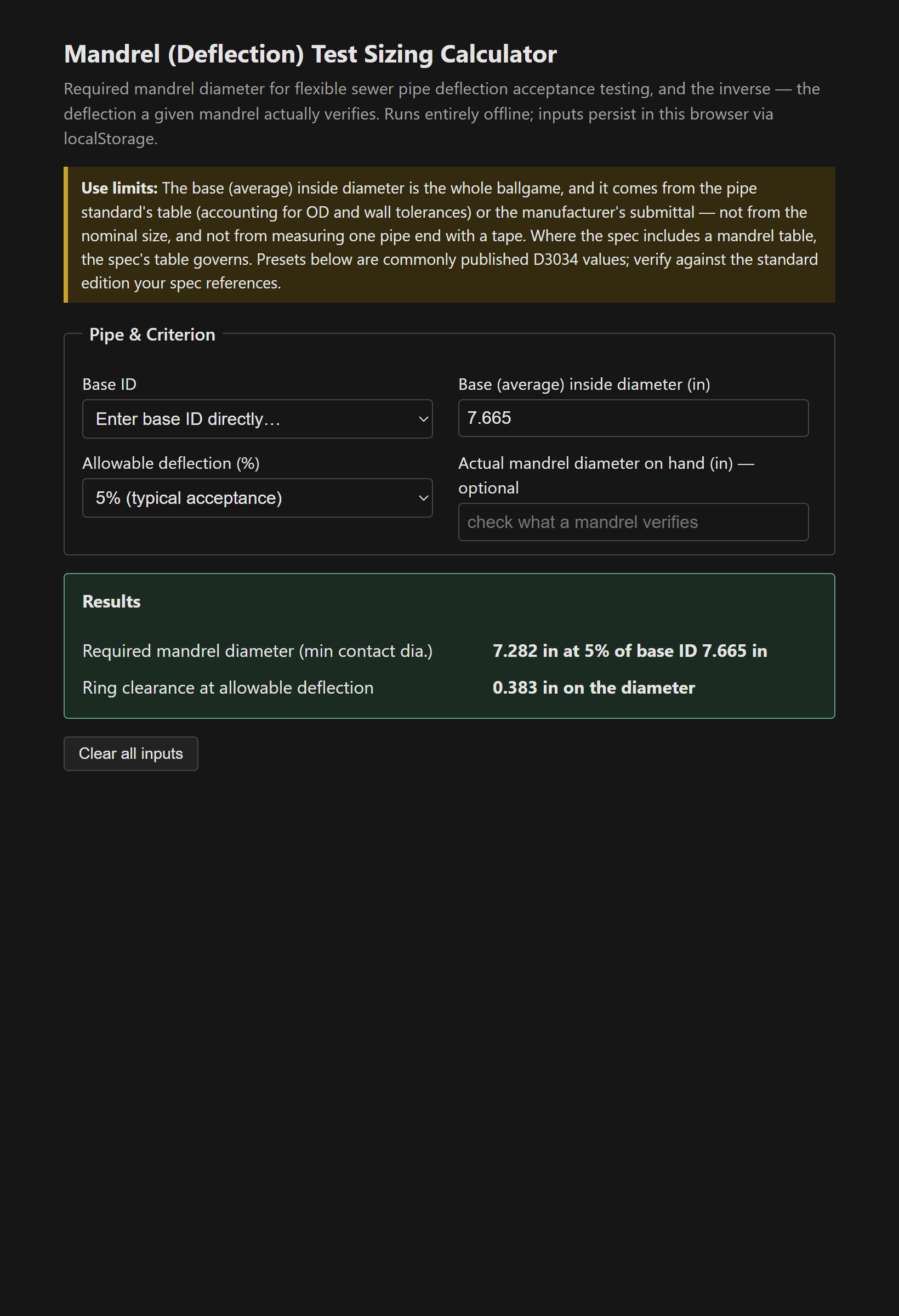
D_mandrel = base ID × (1 − deflection/100)
and the inverse, for when a mandrel already exists and the question is what it actually proves: deflection = (1 − D_mandrel / base ID) × 100.
The base ID is nominal OD minus two average walls, adjusted per the pipe standard — which is why an 8-inch D3034 SDR 35 mandrel at 5% is 7.28 in., not the 7.60 in. you'd get from a nominal ID. The tool carries the common D3034 SDR 35 base IDs (6 in. = 5.742, 8 in. = 7.665, up through 15 in. = 13.898) and takes a custom entry for F679 large-diameter, profile-wall, and HDPE, where the base ID has to come from the applicable standard or the submittal [1].
Test rules that ride along with the size
- The mandrel is rigid with an odd number of legs (typically 9), so two legs can't align across a single flat and read a deflected pipe as round.
- Pulled by hand, no winches. If it takes a comealong, the pipe fails.
- Most specs require the test no sooner than 30 days after backfill, so initial deflection has developed before you measure it.
- Verify the mandrel against a proving ring before the pull — mandrels get dropped and legs get bent, and a bent leg tests a smaller pipe than the paperwork says.
- A failed segment usually means re-excavating and re-compacting the haunching — watching haunch compaction during installation is cheaper than any mandrel.
Single file, vanilla JS, localStorage persistence. The contract's mandrel table governs where one exists — this computes what the table should contain and what a given mandrel actually verifies [2][3].
The tool: Mandrel (Deflection) Test Sizing Calculator.
References
- [1] ASTM D3034 — Type PSM PVC Sewer Pipe and Fittings (dimension tables). https://www.astm.org/
- [2] ASTM D2321 — Underground Installation of Thermoplastic Pipe (installation and deflection context).
- [3] Contract specifications — governing mandrel table, deflection limit, and test timing.