Scaling Pump Performance with the Affinity Laws
The Problem
A pump is rated at one speed and one impeller diameter, but on site you run it on a VFD at 48 Hz, or the shop trimmed the impeller half an inch. The affinity laws tell you what flow, head, and power to expect at the new condition — and just as usefully, they tell you whether a pump that seems to be underperforming is actually broken or just being asked to do something the numbers already predicted.
The Approach
At constant impeller diameter, with speed ratio r = N₂/N₁:
Q₂ = Q₁·r H₂ = H₁·r² P₂ = P₁·r³
Flow scales linearly, head with the square, power with the cube. The same ratios apply approximately to impeller trim with r = D₂/D₁, though that approximation degrades past about a 10–15% cut. Because VFD frequency tracks synchronous speed, the tool lets you enter the ratio as Hz or RPM interchangeably — the small change in induction-motor slip is in the noise [1][2].
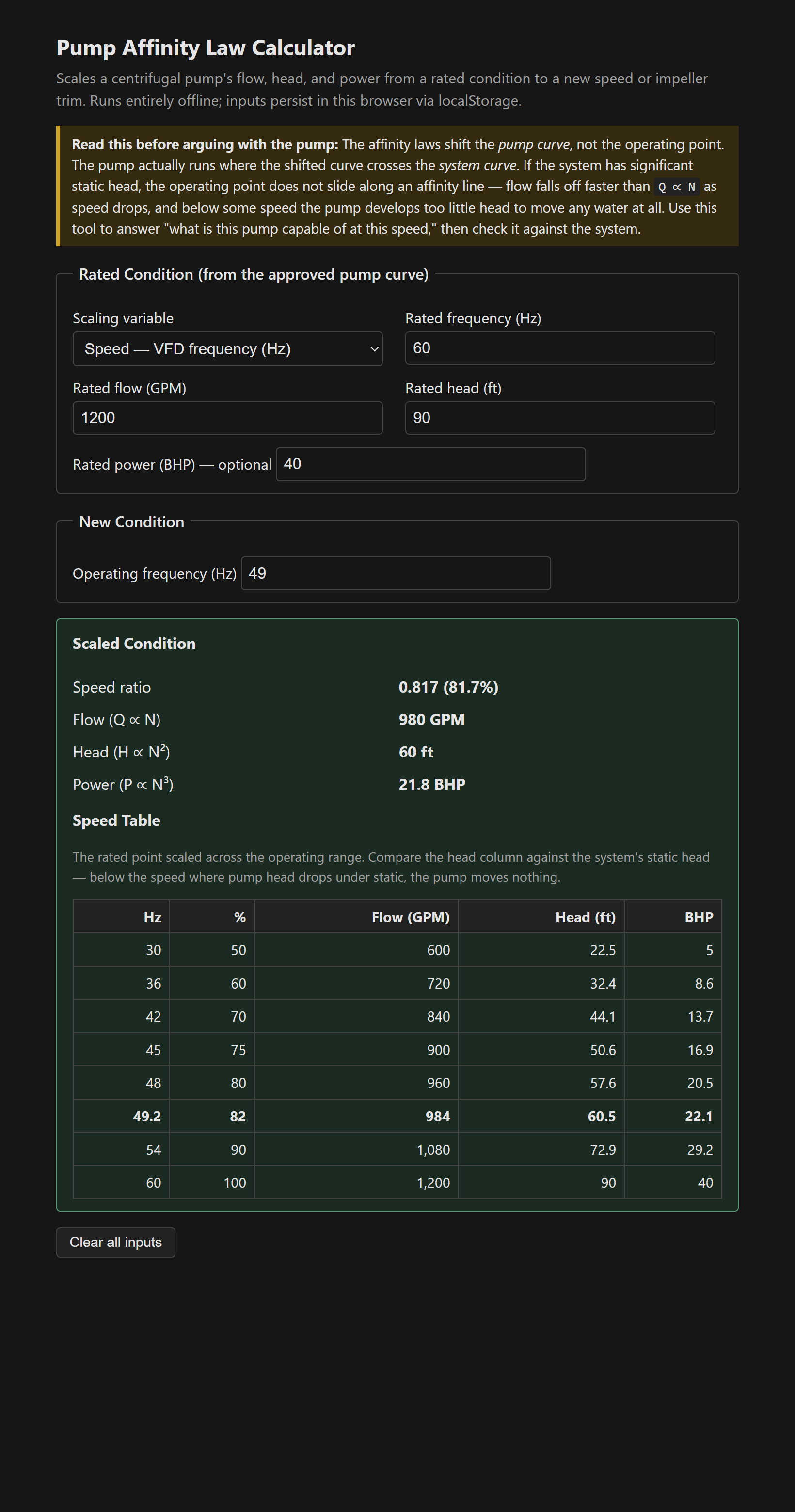
What I actually built the tool around is the troubleshooting pattern, not the arithmetic. The cube law on power is the tell: if a pump's amp draw is well above the r³-scaled expectation, you are probably fighting mechanical drag or pumping something thicker than water. If the pump underperforms at 60 Hz against its curve, the usual suspects are reversed rotation (a three-phase pump runs backward at roughly half flow and head — swap two leads), a plugged impeller, or worn wear rings.
Why low speed isn't free
- Head falls with the square of speed. If static head is a big share of rated head, useful flow disappears well before the drive hits its minimum.
- Shaft-mounted cooling fans slow down too — extended low-speed running reduces motor cooling.
- In wastewater, low speed can drop pipe velocity below the solids-carrying minimum. Many drives set a 40–60% floor for exactly this reason.
One field reminder the tool prints: read the actual speed off the drive keypad, not the commanded setpoint — some drives display one and some the other depending on the parameter shown. Scaling a single point is no substitute for the manufacturer's published family of speed curves when those exist. Single file, vanilla JS, localStorage.
The tool: Pump Affinity Law Calculator.
References
- [1] Hydraulic Institute — ANSI/HI standards on pump performance and variable speed operation. https://www.pumps.org/
- [2] Karassik et al., Pump Handbook — affinity law derivation and trim limitations.
- [3] Manufacturer performance curves for the specific pump.