Why Detention Basins Size on a Storm Longer Than Tc
The Problem
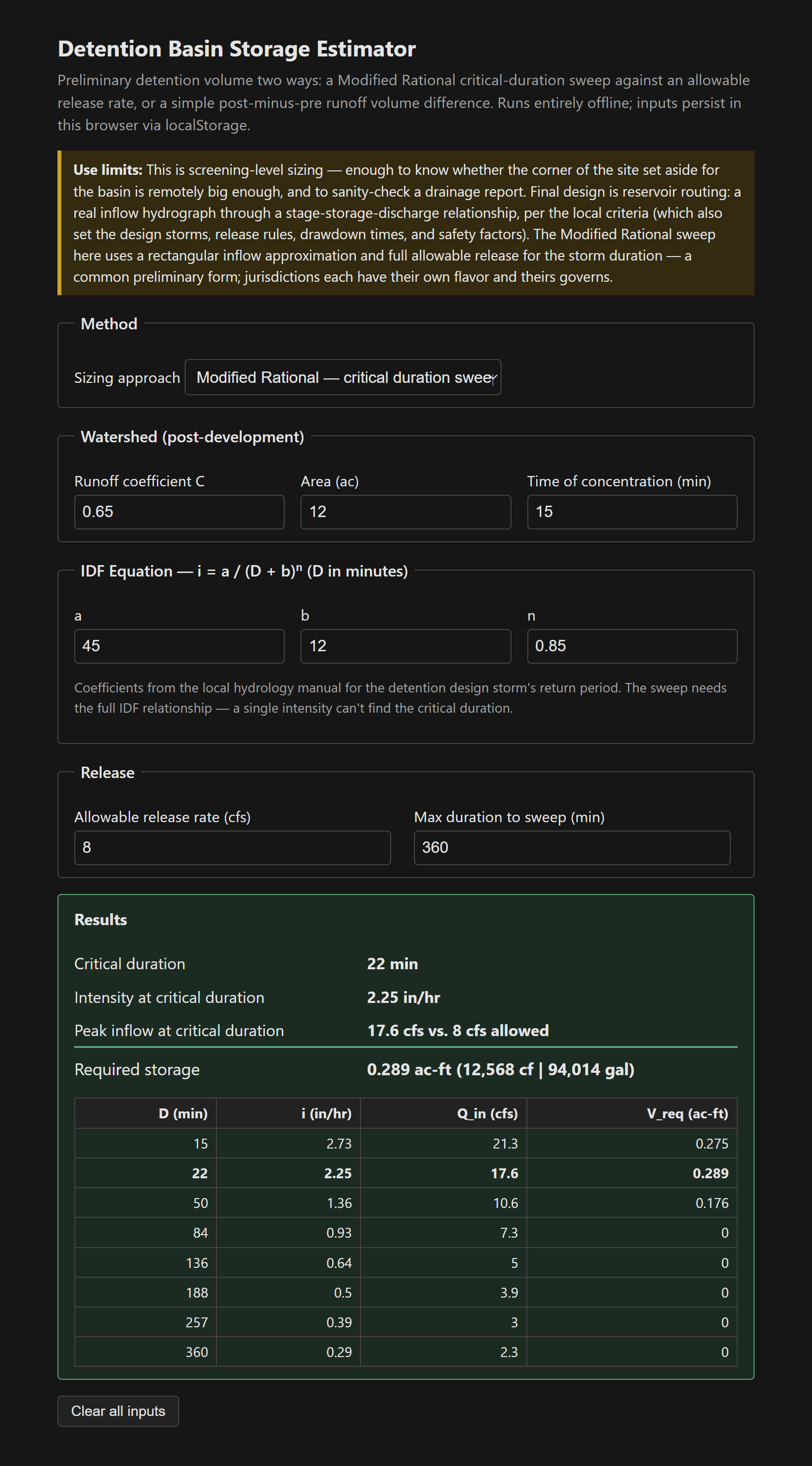
There's a genuinely counterintuitive result buried in detention design, and it trips up people who are perfectly comfortable with peak-flow hydrology: the storm that fills a detention basin fullest is not the storm that produces the peak flow. Size a basin on the time-of-concentration storm — the one you'd use for the pipe — and you'll undersize the basin. This tool exists mostly to make that visible.
The Approach
The Modified Rational method sweeps storm duration. For each trial duration D from Tc up to the sweep limit: intensity i = a/(D+b)ⁿ, inflow Q_in = C·i·A, and required storage as inflow volume minus what the outlet releases over the same window:
V(D) = (Q_in − Q_allow) · D · 60 (cubic feet, rectangular inflow approximation)
Short storms are intense but brief; long storms are big but weak. In between, V(D) peaks — that maximum is the critical duration and the required storage. The tool sweeps 400 durations, finds the max, and shows a representative table with the critical row bolded. And the critical duration always lands longer than Tc, which is the whole point [1].
A second tab does the volume-difference framing — post minus pre runoff volume for the same storm — built to take the TR-55 tool's output directly: run it twice, existing vs. proposed CN, bring the two volumes here. Some criteria want peak-shaving, some want the captured volume, some want the larger of both.
Why this is screening, not final design
- A real outlet doesn't release the allowable rate at every stage — orifice and weir flow vary with head, so the basin fills faster early than the rectangular approximation assumes.
- Stage-storage comes from the actual grading; the last foot of a shallow basin holds far more than the first.
- The sweep can't see multi-storm criteria, drawdown-time limits (vector control is serious business in Southern California), freeboard, or spillway sizing. Routing through a real stage-storage-discharge relationship governs the final number.
- If the preliminary volume barely fits the footprint, it won't survive routing. Leave margin.
The tool's warnings carry the practical wisdom too: a max landing at the end of the sweep range means extend it (the true critical duration is longer still), and a never-exceeds-release result gets a “check that Q_allow isn't in GPM” nudge. Single file, vanilla JS, localStorage persistence [2][3].
The tool: Detention Basin Storage Estimator.
References
- [1] The local county hydrology/drainage manual — governing method, storms, release rates, and drawdown requirements.
- [2] NRCS TR-55 / TR-20 and reservoir routing texts — hydrograph methods for final design.
- [3] ASCE MOP 77 / WEF MOP FD-20 — urban stormwater detention design practice.