Curve Number Runoff and When Area-Weighting Lies
The Problem
The NRCS curve number method turns a design storm depth into a runoff depth through a single parameter, CN, that rolls up land cover and soil into one number between roughly 30 and 98. It's the backbone of small-site drainage. And most CN calculators quietly do one thing that TR-55 itself warns against — they area-weight the curve numbers — without ever mentioning it can understate the runoff.
The Approach
The runoff equation, run properly including the zero-runoff branch:
Q = (P − I₀)² / (P − I₀ + S), with S = 1000/CN − 10 and I₀ = 0.2S (inches)
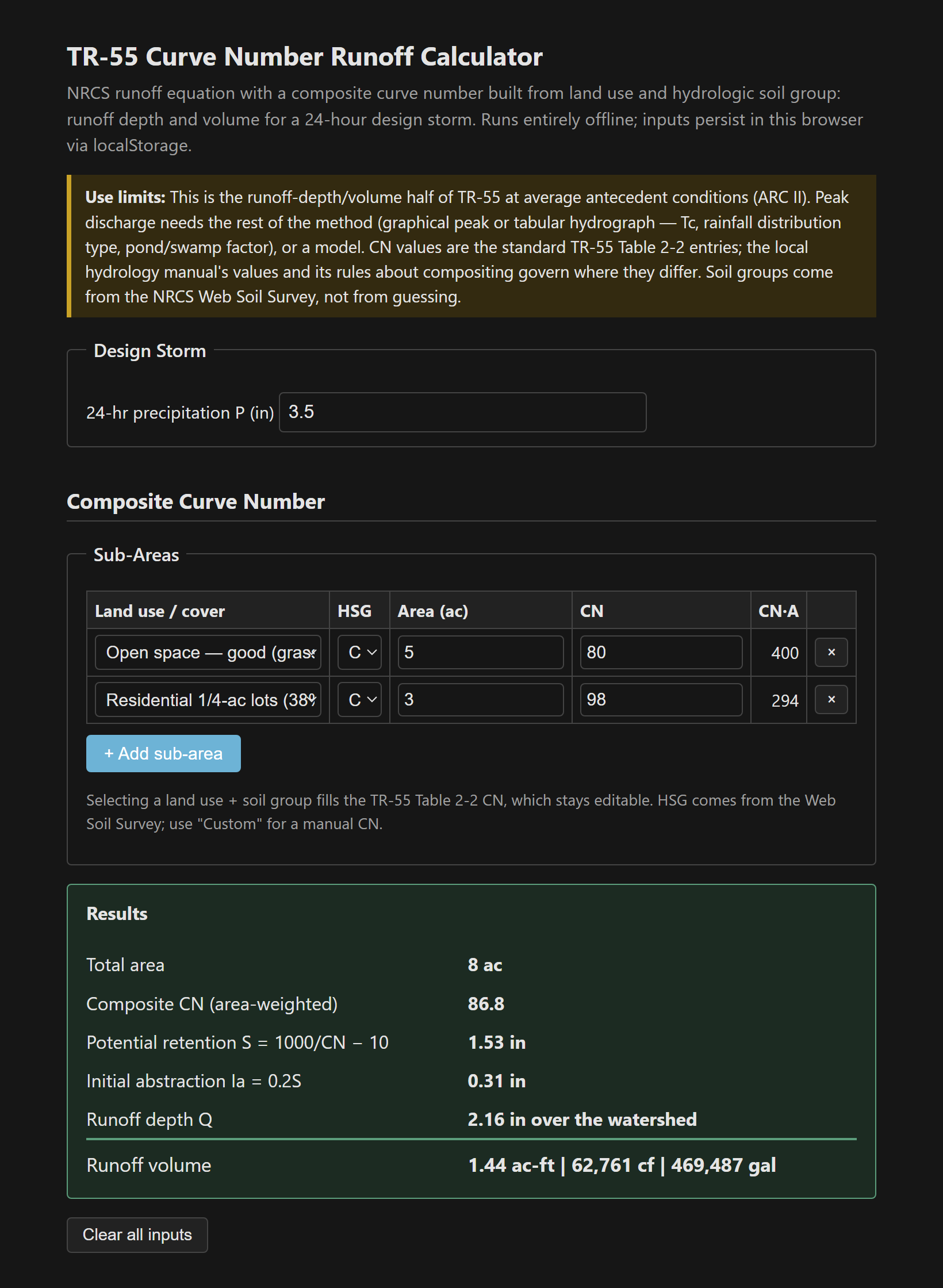
If P ≤ I₀ the storm never exceeds the initial abstraction and runoff is zero. The composite CN builder bakes in the TR-55 Table 2-2 presets — twelve land-use rows crossed with hydrologic soil group A–D, prefilling an editable CN — and the tool is explicit that HSG comes from the NRCS Web Soil Survey, not a guess [1][4]. Output lands in depth (inches), acre-feet, cubic feet, and gallons.
Where area-weighting goes wrong
When sub-areas mix low-CN pervious ground with impervious surfaces — and especially when the impervious area is unconnected, draining across lawn before it reaches a pipe — averaging the CNs can misstate runoff. TR-55's own Figures 2-3 and 2-4 exist to adjust for exactly this. The honest move when precision matters is to compute runoff per cover type and sum the volumes, rather than run one storm against one blended CN. The tool says so, and adds a companion caveat: a real site with connected impervious area still sheds water even when the composite CN says the storm produced zero runoff [1].
The other assumptions worth stating out loud
- Table values are average antecedent runoff condition (ARC II); wet/dry conversions exist but most criteria just use II.
- The method is unreliable when Q computes to a few hundredths of an inch — real-world scatter swamps it. The tool flags Q under 0.05 in.
- This is the runoff-volume half of TR-55. Peak discharge needs Tc, the rainfall distribution type, and the graphical/tabular method or a model.
Single file, vanilla JS, localStorage persistence [2][3].
The tool: TR-55 Curve Number Runoff Calculator.
References
- [1] NRCS TR-55 — Urban Hydrology for Small Watersheds (runoff equation, Table 2-2, composite CN guidance). https://www.nrcs.usda.gov/
- [2] NRCS National Engineering Handbook, Part 630 Ch. 9–10 — curve number theory.
- [3] NOAA Atlas 14 — design precipitation. https://hdsc.nws.noaa.gov/pfds/
- [4] NRCS Web Soil Survey — hydrologic soil groups. https://websoilsurvey.nrcs.usda.gov/