Peak Flow by the Rational Method with a TR-55 Tc Builder
The Problem
Q = CiA is the first equation anyone learns for storm drainage, and it's deceptively easy: a runoff coefficient, a rainfall intensity, an area, multiply. The catch is the intensity. The Rational Method assumes the peak happens when the whole watershed is contributing at once — when the storm has lasted exactly as long as the time of concentration — so you read intensity off the IDF curve at Tc. Get Tc wrong and everything downstream of it is wrong, and Tc is the input people hand-wave.
The Approach
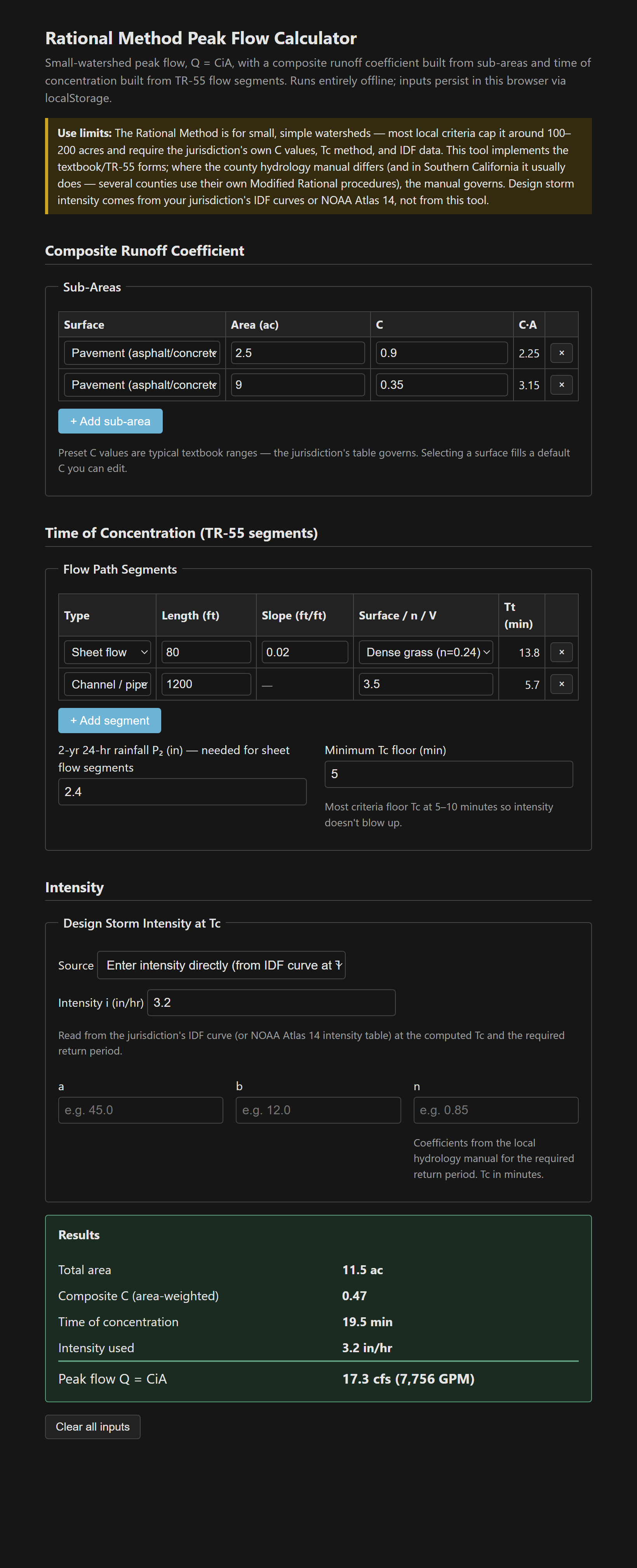
The tool has two builders feeding the one equation. A composite-C builder takes line-item sub-areas (roof, pavement, gravel, lawn presets that prefill an editable C) and area-weights them: C = ΣC·A / ΣA. And a Tc builder that sums TR-55 travel-time segments along the flow path, because that's where the real error lives [1]:
- Sheet flow (first ≤100 ft):
Tt = 0.007·(nL)^0.8 / (P₂^0.5 · s^0.4), with the sheet-flow roughness n and the 2-year 24-hour rainfall P₂ from Atlas 14 [2]. - Shallow concentrated flow:
V = 20.328√spaved or16.135√sunpaved, thenTt = L/(3600V). - Channel flow: you enter V — and if you want it honestly, compute it in the Manning's calculator for the actual section. The two tools are a natural pair.
Intensity comes either straight off your IDF curve or from the power-law fit i = a/(Tc+b)^n with jurisdiction coefficients, auto-evaluated at the computed Tc. It warns past the method's area applicability limit and when composite C climbs above 0.95.
The reviewer's-eye failure modes
- The single most common Rational Method error is a Tc path that isn't the hydraulically longest one — walking the site beats tracing the obvious swale on the plan.
- An absurdly short Tc (all pipe, steep site) drives intensity and Q way up. That's the model working correctly, and it's why criteria floor Tc (default 5 min here).
- For pre- vs. post-development, keep the same method, storm, and IDF source on both sides or the comparison is meaningless.
One code note from building it: the Tc table used to re-render on every keystroke, which stole focus mid-edit. Length/slope/velocity changes now update only the affected computed cell in place. Single file, vanilla JS, localStorage persistence. Southern California counties mostly run their own Modified Rational procedures — the county manual governs [3].
The tool: Rational Method Peak Flow Calculator.
References
- [1] NRCS TR-55 — Urban Hydrology for Small Watersheds (travel time methods). https://www.nrcs.usda.gov/
- [2] NOAA Atlas 14 — Precipitation-Frequency Data Server. https://hdsc.nws.noaa.gov/pfds/
- [3] The local county hydrology manual — governing C values, Tc method, IDF data, and applicability limits.